
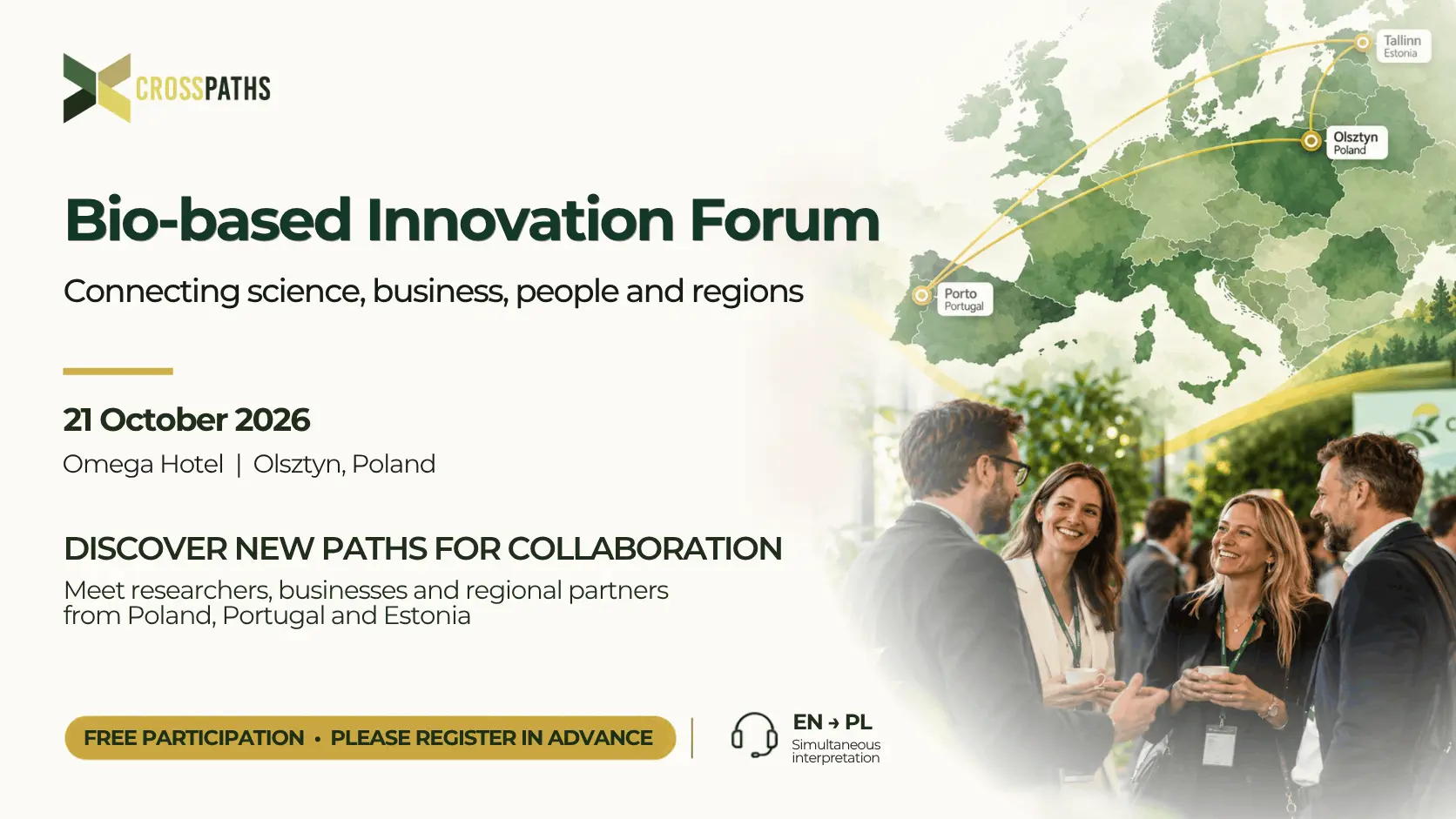
On 21 October 2026, the CROSSPATHS consortium will bring together researchers, entrepreneurs, innovation professionals and regional stakeholders in Olsztyn, Poland, for the Bio-based Innovation Forum. This international conference will explore how scientific expertise, business experience and cross-border collaboration can unlock new opportunities in the bioeconomy, strengthen innovation ecosystems and transform promising research into market-ready solutions.
Building Bridges Between Research and Industry
Europe's transition towards a more sustainable, circular and competitive economy depends on its ability to transform scientific knowledge into practical innovation. Across the continent, research institutions are developing new technologies, identifying valuable compounds in underused biological resources and exploring solutions that could reshape the agri-food, biotechnology, cosmetics and health-related industries.
Yet scientific excellence alone is not enough to bring innovation to market.
Research organisations and businesses often operate within different environments, with distinct priorities, resources and expectations. While researchers seek to advance knowledge and demonstrate the potential of new technologies, companies must consider production costs, regulatory requirements, consumer demand, scalability and commercial viability.
Bridging these perspectives is essential to ensure that promising scientific discoveries translate into products, services and technologies that generate economic, environmental and societal value.
This challenge lies at the heart of the Bio-based Innovation Forum, organised by the CROSSPATHS consortium on 21 October 2026 at the Omega Hotel in Olsztyn, Poland.
Under the theme Connecting Science, Business, People and Regions, the Forum will create a meeting point for stakeholders interested in developing new products, identifying research partners and exploring opportunities for international collaboration.
The event will particularly highlight the potential of agri-food side streams and underused biological resources, while recognising that the technologies and expertise developed within the bioeconomy can support innovation across several industrial sectors.
Participants will have the opportunity to discover complementary research capabilities, learn from entrepreneurial experiences, discuss the conditions required for successful innovation and establish connections with organisations from Poland, Portugal, Estonia and beyond.
More than a conventional scientific conference, the Forum aims to encourage practical exchanges between people who possess different but complementary knowledge, resources and ambitions.
CROSSPATHS: Strengthening Europe's Research and Innovation Ecosystem
The Bio-based Innovation Forum represents an important step in the development of CROSSPATHS, a project funded by the European Union's Horizon Europe programme under its Widening Participation and Strengthening the European Research Area component.
CROSSPATHS was established to reinforce international cooperation between research and innovation institutions working in food technology, health and the bioeconomy.
Its approach focuses on strengthening institutional capacities, improving the use of existing research infrastructures and facilitating access to European research and innovation opportunities.
The project brings together six organisations:
- InLife Institute of Animal Reproduction and Food Research, Polish Academy of Sciences (Poland), the project coordinator.
- Universidade Católica Portuguesa (Portugal).
- Estonian University of Life Sciences (Estonia).
- Wageningen Research (Netherlands).
- Innotrope (France).
Together, these partners combine scientific expertise, research infrastructure, innovation management capabilities and experience in international cooperation.
Through training activities, staff exchanges, strategic workshops, networking events and joint service development, CROSSPATHS seeks to establish lasting relationships that extend beyond the project's duration.
A particularly important dimension is the development of synergies between regional investments in research infrastructure and opportunities available through European research and innovation programmes.
By improving institutional capacities and connecting complementary resources across borders, CROSSPATHS contributes to a more integrated and competitive European research landscape.
The Bio-based Innovation Forum builds upon this work. After developing relationships and shared capabilities among consortium partners, the project is increasingly focusing on making these resources accessible to external organisations.
The objective is to move from internal cooperation towards a broader ecosystem of research institutions, companies and innovation stakeholders capable of developing new initiatives together.
This ambition will guide the Forum's programme, which combines scientific presentations, entrepreneurial perspectives, discussions on inclusive leadership and reflections on regional and European innovation policies.
From Agri-Food Side Streams to High-Value Bio-Based Products
One of the central themes of the Forum will be the transformation of agri-food side streams and underused biological resources into valuable ingredients, materials and products.
Food production and processing generate substantial quantities of by-products, many of which contain potentially valuable compounds such as proteins, fibres, polyphenols and other bioactive substances.
Although some of these resources are already used for animal feed, energy production or other applications, opportunities remain to develop higher-value uses through scientific research and technological innovation.
For example, compounds extracted from agricultural or food-processing side streams may offer opportunities for developing functional food ingredients, cosmetic formulations or biotechnology applications.
However, moving from an interesting biological resource to a commercially viable product requires several stages of development.
Researchers must first characterise the resource, identify its potentially valuable components and assess their functional properties. Depending on the intended application, additional studies may be necessary to evaluate biological activity, safety, stability and performance.
Companies must then determine whether the proposed solution can be produced consistently, economically and at an appropriate scale.
This process illustrates why collaboration between scientific institutions and businesses is so important.
Research organisations can provide access to specialised equipment, analytical methods and scientific expertise that companies may not possess internally. Businesses, in turn, contribute knowledge of market requirements, industrial constraints and customer expectations.
The Bio-based Innovation Forum will explore these complementary roles and encourage participants to identify opportunities where scientific capabilities can address concrete industrial challenges.
Although the agri-food sector provides the starting point, the discussion will extend to other industries where bio-based technologies and research services can contribute to product development and innovation.
Scientific Excellence Through Complementary Research Capabilities
The scientific session, scheduled from 09:30 to 10:30, will demonstrate how the research expertise and infrastructures of CROSSPATHS partners can support new collaborations.
Moderated by Ana Paulo from Universidade Católica Portuguesa, the session will bring together representatives of three research institutions:
- Reelika Rätsep, Estonian University of Life Sciences, Estonia.
- Manuela Pintado, Universidade Católica Portuguesa, Portugal.
- Bartosz Fotschki, InLife Institute, Poland.
The presentations will introduce the institutions' complementary expertise and research infrastructures, highlighting opportunities for cooperation with companies, researchers and other external partners.
The session reflects an important principle underlying CROSSPATHS: research infrastructures can generate greater value when their capabilities are connected and made accessible beyond individual institutions.
Modern scientific research increasingly requires multidisciplinary approaches. Developing a new food ingredient, for instance, may involve analytical chemistry, microbiology, biotechnology, nutritional science and biological validation.
Few organisations possess every capability required to address such challenges independently.
By connecting specialised research facilities and expertise across different countries, CROSSPATHS aims to provide a broader and more integrated range of services.
This approach can be particularly valuable for small and medium-sized enterprises, which often face difficulties accessing advanced research infrastructures or identifying suitable scientific partners.
Rather than investing independently in expensive equipment or developing all necessary capabilities internally, companies may benefit from collaborating with institutions that already possess the required expertise.
The scientific session will therefore provide an opportunity to understand not only what each institution can offer individually, but also how their capabilities can be combined to support more ambitious innovation projects.
Introducing the CROSSPATHS Joint Research and Innovation Services
A key moment of the conference will be the presentation of the joint CROSSPATHS research and innovation support services.
At 09:20, Ana Paulo will introduce the consortium's shared service offer and the platform designed to connect external organisations with the expertise and research infrastructure available across the partnership.
This initiative represents a concrete outcome of the cooperation developed within CROSSPATHS.
By bringing together scientific competences and infrastructure capabilities from different institutions, the consortium aims to make it easier for external stakeholders to identify potential partners and access relevant research support.
For businesses, this could help address challenges such as identifying valuable compounds, evaluating the properties of new ingredients or exploring the technological feasibility of innovative products.
For research organisations, the joint offer creates opportunities to develop multidisciplinary studies, establish new collaborations and participate in international innovation initiatives.
More broadly, the initiative seeks to reduce fragmentation within the research and innovation ecosystem.
Access to expertise is not simply a matter of identifying a laboratory or a piece of equipment. Successful collaboration also requires a shared understanding of objectives, clear communication, appropriate project management and alignment between scientific activities and expected outcomes.
By developing a coordinated approach, CROSSPATHS aims to facilitate these interactions and help transform initial contacts into productive partnerships.
The Forum will provide an opportunity for participants to discover this joint offer and explore how it may support their own research, technological development or commercial innovation activities.
Turning Scientific Knowledge into Market Solutions
Scientific discoveries generate their greatest impact when they can be translated into solutions that respond to real-world needs.
Yet the transition from research to market is rarely straightforward.
Promising technologies may encounter difficulties related to production costs, regulatory requirements, industrial scalability, intellectual property or insufficient market demand.
Addressing these challenges requires more than scientific expertise. It also calls for entrepreneurial experience, strategic decision-making and effective cooperation between research institutions and industry.
These issues will be explored during the Forum's business session, scheduled from 11:00 to 12:00.
Moderated by Eduardo Costa from Universidade Católica Portuguesa, the discussion will feature entrepreneurs who will share their perspectives on developing innovative products and bringing them to market.
Confirmed participants include Annemari Polikarpus, CEO of Viinamärdi Talu OÜ in Estonia, and Raquel Madureira, General Manager of Biorbis in Portugal.
The session will address several interconnected questions.
How can businesses identify commercially relevant opportunities emerging from scientific research? What makes cooperation with research institutions effective? Which obstacles arise when developing innovative products, and how can companies overcome them?
Particular attention will be given to the challenges of commercialisation, scaling up and market entry, as well as the influence of regional innovation environments.
These questions are especially relevant to bio-based innovation, where technical feasibility must be considered alongside economic and environmental sustainability.
A process that performs well under laboratory conditions may require significant adaptation before industrial implementation. Similarly, a scientifically promising ingredient must meet the expectations of manufacturers, regulators and consumers before it can become a successful commercial product.
By sharing entrepreneurial experiences, the business session will complement the scientific presentations and help participants better understand the practical requirements of innovation.
The objective is to encourage a dialogue in which research institutions become more familiar with industrial needs, while businesses gain a clearer understanding of how scientific expertise can support their development strategies.
Inclusive Leadership: Why Different Perspectives Strengthen Innovation
Technological capabilities and financial resources are important drivers of innovation, but the people involved in research and business collaborations are equally essential.
Successful partnerships depend on communication, trust, leadership and the ability to bring together individuals with different backgrounds and perspectives.
For this reason, the Bio-based Innovation Forum will dedicate a full session to inclusive leadership and the contribution of diversity to stronger organisations and partnerships.
Scheduled from 12:00 to 13:00, the session will open with a presentation by Aleksandra Niżyńska, a Polish diversity, inclusion and communications expert.
Her introduction will examine the importance of equal opportunities, inclusive leadership and the participation of different perspectives in organisational decision-making.
The presentation will be followed by a panel discussion featuring:
- Débora Campos, CEO of AgroGrIN Tech, Portugal.
- Monika M. Kaczmarek, Director General of the InLife Institute, Poland.
- Iwona Kieda, WeLead Food, Poland.
Moderated by Aleksandra Niżyńska, the discussion will address leadership challenges, barriers encountered by women in science and business, and the conditions required to ensure that different voices can meaningfully influence decisions.
This dimension is particularly relevant in international research and innovation partnerships.
Cross-border collaboration brings together people working within different institutional cultures, professional environments and national contexts.
These differences can become a source of creativity and innovation when organisations establish effective mechanisms for cooperation and mutual understanding.
Inclusive leadership can help teams benefit from diverse expertise, challenge assumptions and consider alternative approaches to complex problems.
It also contributes to creating environments in which individuals feel able to share ideas, raise concerns and participate in strategic discussions.
By incorporating these questions into a conference primarily focused on scientific and technological innovation, CROSSPATHS highlights the importance of the human and organisational dimensions of successful collaboration.
The session will encourage participants to consider how leadership practices and organisational cultures can support more effective, resilient and sustainable partnerships.
Creating the Right Conditions for Regional and European Collaboration
The final thematic session of the Forum will focus on the policy and institutional conditions that enable innovation partnerships to develop and succeed.
Research institutions and companies do not operate in isolation. Their capacity to innovate is influenced by regional strategies, public investment, access to infrastructure, support services and European cooperation opportunities.
Regional authorities, technology transfer organisations and European networks can therefore play a decisive role in connecting stakeholders and helping innovative ideas progress towards implementation.
From 14:00 to 15:00, three speakers will explore these issues from complementary perspectives.
Peter Jongebloed, from Wageningen University & Research in the Netherlands, will address the factors that transform initial contacts into competitive and lasting European partnerships.
Drawing on experience in European research and innovation programmes, his presentation will consider the importance of complementary expertise, mutual trust, international networks, institutional support and long-term strategic thinking.
Piia Pääso, from the Estonian University of Life Sciences, will discuss the role of regional technology transfer structures and competence centres.
Her contribution will examine how these organisations can connect research capabilities with business needs, facilitate access to infrastructure and support the practical application of scientific knowledge.
Finally, Marcin Szczepkowski, representing the Marshal's Office of the Warmian-Masurian Voivodeship in Poland, will provide a regional perspective on supporting businesses and innovation.
His presentation will explore how regional authorities can encourage cooperation between companies, research institutions and public organisations.
Together, these contributions will highlight the importance of developing coherent innovation ecosystems in which scientific capabilities, entrepreneurial initiatives and institutional support reinforce one another.
This perspective closely reflects the objectives of CROSSPATHS, particularly its ambition to improve the use of research infrastructures supported by regional investment and strengthen participation in European research and innovation activities.
From International Networking to Long-Term Partnerships
The Bio-based Innovation Forum builds on several years of activities designed to strengthen cooperation between the CROSSPATHS partners and the wider European research and innovation community.
Throughout the project, the consortium has organised workshops, staff exchanges, study visits, training activities and networking initiatives.
These activities have helped participating organisations exchange knowledge, identify complementary capabilities and develop stronger institutional relationships.
An important milestone was the CROSSPATHS Matchmaking Event held in Brussels on 25 March 2026, which brought together more than 60 participants from across Europe.
That event focused on establishing partnerships for future research and innovation initiatives, particularly in areas associated with Horizon Europe Cluster 6, including sustainable food systems, circular economy, bioeconomy and biodiversity.
Through presentations, thematic discussions and bilateral meetings, participants were encouraged to identify complementary expertise and explore potential joint projects.
The Bio-based Innovation Forum takes this collaborative approach further by placing greater emphasis on the practical interface between scientific expertise, industrial innovation and regional development.
It also offers an opportunity to introduce the joint research and innovation services developed by the consortium to a wider audience.
For CROSSPATHS, the long-term value of these initiatives lies in their ability to generate relationships and cooperation opportunities that continue beyond individual events.
A successful partnership is rarely established through a single meeting. It develops through continued dialogue, shared objectives and the gradual identification of concrete opportunities for collaboration.
By connecting researchers, entrepreneurs and institutional stakeholders, the Forum aims to support this process and contribute to the emergence of new scientific and business relationships.
Join the Bio-based Innovation Forum in Olsztyn
The Bio-based Innovation Forum is open to researchers, companies, entrepreneurs, business support organisations, regional authorities and other stakeholders interested in scientific collaboration and bio-based innovation.
Whether participants are seeking research expertise, exploring a new product concept, looking for technological partners or interested in strengthening their international networks, the Forum offers opportunities to exchange knowledge and establish valuable contacts.
21 October 2026, 09:00–15:00
Omega Hotel, ul. Sielska 4A, Olsztyn, Poland
English, with simultaneous interpretation into Polish
Free participation; advance registration required
The conference programme will provide a combination of scientific presentations, business perspectives, discussions on leadership and reflections on the institutional conditions supporting innovation.
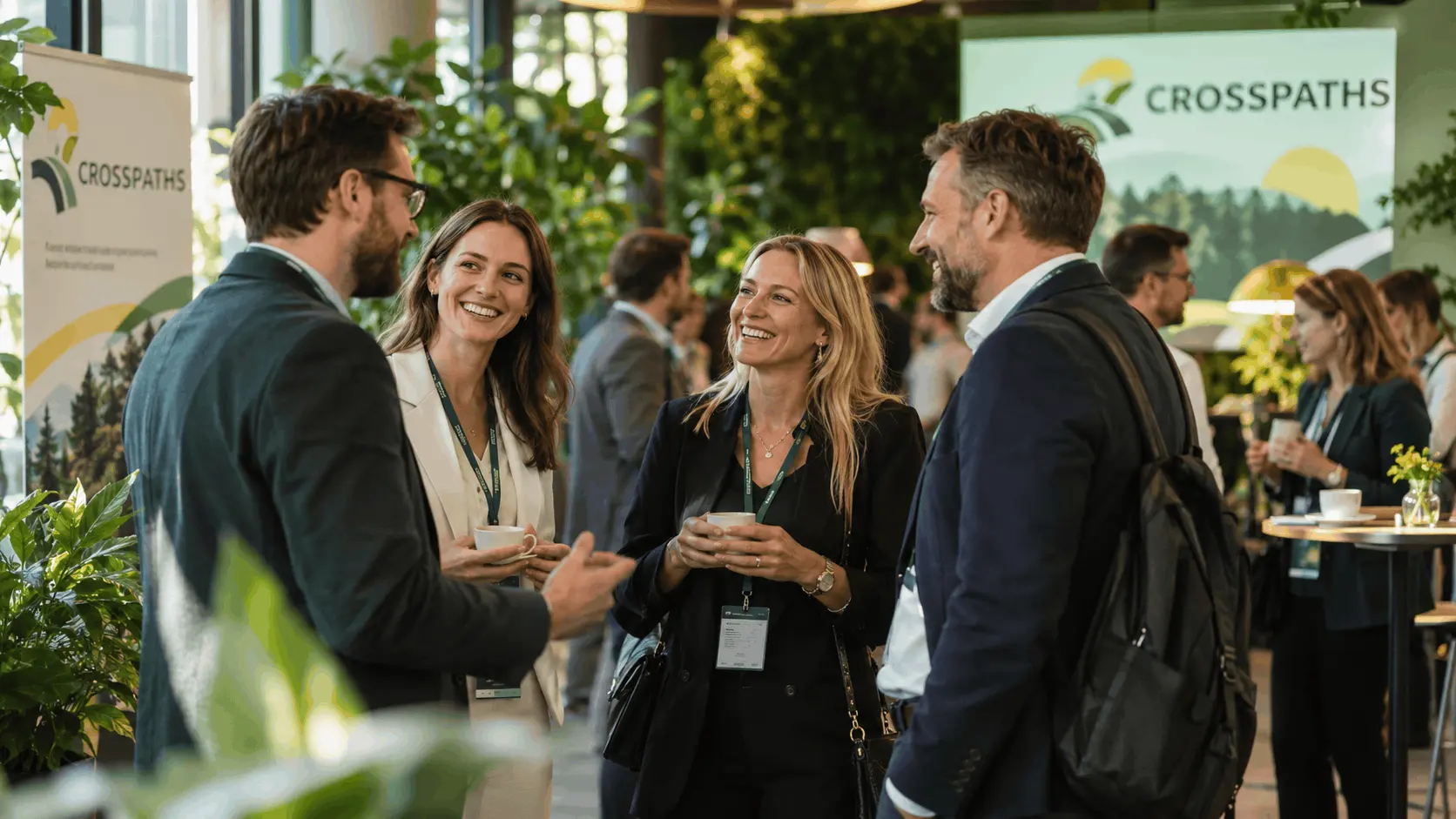
Networking opportunities, including coffee breaks and lunch, will allow participants to continue discussions, exchange ideas and explore potential cooperation.
Looking Ahead: A More Connected European Bioeconomy
The challenges facing Europe's bioeconomy require solutions that extend beyond individual scientific disciplines, industrial sectors and national borders.
Developing sustainable products, improving resource efficiency and strengthening industrial competitiveness all depend on the capacity to connect scientific knowledge with practical needs.
Equally important is the ability to establish lasting relationships between organisations with complementary expertise and resources.
The Bio-based Innovation Forum embodies this approach by bringing together the scientific, entrepreneurial, human and institutional dimensions of innovation.
For CROSSPATHS, the event represents an opportunity to demonstrate the value of international cooperation and introduce the capabilities developed through the project to new stakeholders.
It also reinforces a central message: innovation becomes more effective when research institutions, businesses and regional ecosystems work together towards shared objectives.
By opening new pathways for collaboration, CROSSPATHS aims to contribute to a European research and innovation landscape that is more connected, inclusive and capable of transforming scientific excellence into meaningful economic and societal impact.
The Bio-based Innovation Forum in Olsztyn will provide another opportunity to advance that ambition.


