

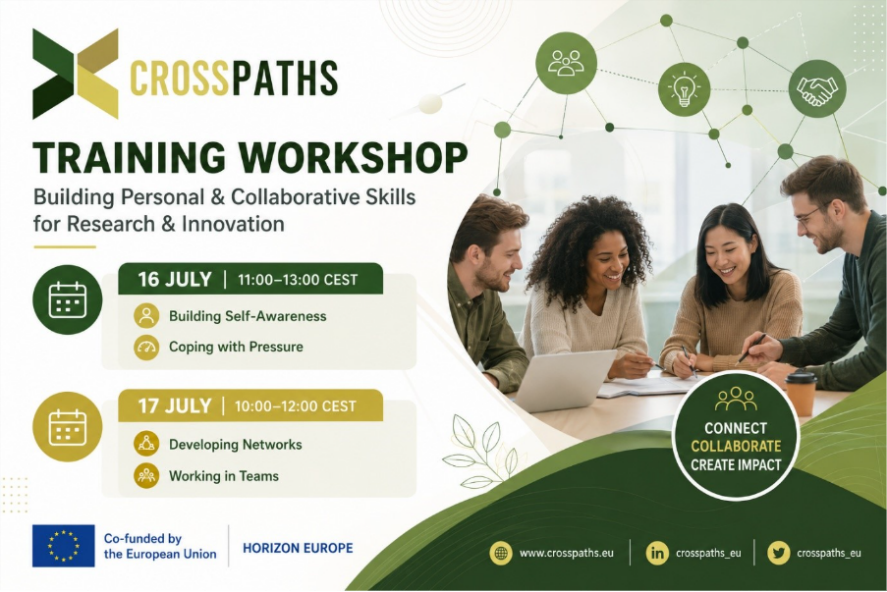
Successful scientific careers require more than scientific expertise. Researchers need strong interpersonal, leadership, and collaborative skills to work effectively across disciplines, sectors, and cultures. Recognising this need, the CROSSPATHS consortium organised the Building Personal & Collaborative Skills for Research and Innovation training, held online on 16 and 17 July 2026.
Delivered by Wageningen University & Research (WUR), with organisational support from Universidade Católica Portuguesa (UCP), the training aimed to equip researchers with transferable skills to support their personal and professional development and help them navigate today’s increasingly collaborative research and innovation landscape.
The Challenge
Research environments are becoming increasingly international, interdisciplinary, and collaborative. While researchers receive extensive scientific training, opportunities to develop essential transferable skills — such as leadership, communication, networking, resilience, and teamwork — are not always available.
This highlighted the need for training opportunities that complement scientific expertise with the personal and interpersonal skills required to navigate complex research environments, build effective working relationships, and respond constructively to professional challenges.
The Initiative
Over two interactive online sessions, participants explored key topics related to personal development and collaboration, including self-awareness, emotional intelligence, coping with pressure, networking, teamwork, and collaborative leadership.
The training adopted a highly interactive approach, combining theoretical inputs with practical exercises, group discussions, and self-reflection activities. Bringing together researchers from different institutions and disciplinary backgrounds, the sessions created an open learning environment in which participants could exchange experiences, discuss challenges encountered in research settings, and reflect on how individual behaviors and working styles influence communication and team dynamics.
The training was led by Riti Hermán Mostert, Multi-Stakeholder Partnerships Advisor at Wageningen Social & Economic Research, who brings over 20 years of experience in food systems leadership and reflexive learning.
Reflecting on the training and the broader CROSSPATHS approach, Riti highlighted the importance of creating supportive and psychologically safe environments where researchers can develop both individual and relational leadership capacities:

“The CROSSPATHS programme brought researchers and academics together who value the kind of leadership that leads to collaboration and a culture of care and support. Researchers and especially young researchers thrive and excel in their work when they feel secure and seen. The environment should be psychologically safe and interpersonal relations have to be strong. An environment where learning -and yes even mistakes- are welcomed. Researchers (don't we all?) need security and support so that each person can achieve its potential and the collective can perform to create outstanding results. Self-development and opportunities to learn to navigate the realities of academia and research institutes are key. CROSSPATHS creates spaces where academics and researchers can come together and build their leadership capacities which move beyond the individual skills to relational aspects of their work environment. This benefits the individual and their direct circle of co-workers. We often call these ‘soft’ skills, but don’t underestimate how excruciatingly ‘hard’ your department is when these skills are absent. If an institution welcomes these skills it could bring the whole organisation to a human centred excellence.”
The Impact
The training provided participants with practical tools and approaches, including the Eisenhower Matrix, Leary’s Rose and the Johari Window, as well as strategies for giving and receiving feedback and improving listening skills. These tools and approaches focused on task prioritisation, understanding interpersonal dynamics, and strengthening self-awareness and communication. Through reflection and hands-on activities, participants explored ways to manage pressure, strengthen teamwork, and better understand their own behaviours and interactions with others.
The participants’ feedback offers a valuable perspective on the experience and its relevance to their professional lives. Their testimonials highlight the practical nature of the training, the opportunity for self-reflection, and the usefulness of the tools and approaches introduced during the sessions.

"Participating in the 'Building Personal & Collaborative Skills for Research and Innovation' workshop was a truly valuable experience. The sessions gave me practical tools I hadn't used before, such as the Eisenhower Matrix for prioritizing tasks, Leary's Rose for understanding interpersonal dynamics, and the Johari Window for improving self-awareness and communication. What I found most valuable was how directly applicable these frameworks are to research environments, especially for leading multidisciplinary teams and building stronger collaborations. This training has genuinely shifted how I approach teamwork and communication in my research and teaching, and I'm looking forward to applying these lessons going forward. Many thanks to the CROSSPATHS team and Vanya Simeonova for such an engaging and thought-provoking session."
Name: Dulmini Nanayakkara Sapugahawatte
Affiliation: Research fellow, Institute of Veterinary Medicine and Animal Science, Estonian University of Life Sciences (Eesti Maaülikool)

“The training was an interesting experience that allowed me to look at self-awareness, coping with pressure, and teamwork from a different perspective. I found some of the topics of the training, focusing on networking and teamwork, particularly interesting, as it covered topics that I can directly relate to in my everyday work.
I appreciated the number of practical exercises and the opportunity to exchange experiences with other participants, which helped to make the topics more engaging and relevant. The training also encouraged me to reflect on my own communication and collaboration style, as well as how I respond to different situations in a professional environment.
Overall, the training was useful and gave me some new ideas to think about. It also encouraged me to reflect on my communication style and the way I work with other people. I think the practical part of the training was especially valuable.”
Name: Elżbieta Laniecka
Affiliation: Lab Manager Open Space Amber, InLife, Institute of Animal Reproduction and Food Research Polish Academy of Sciences.

“Participating in the “Building Personal & Collaborative Skills for Research and Innovation” training was particularly meaningful to me because it highlighted something that is sometimes overlooked in academic and research environments: the quality of research outputs depends not only on scientific and technical expertise, but also on how well we understand ourselves, communicate with others, and build effective working relationships. These skills are particularly important when working under pressure and uncertainty, as often happens during a PhD, but also when collaborating in international projects such as CROSSPATHS. European consortia bring together people from different cultural and professional backgrounds, and understanding these differences can help us communicate better, strengthen collaboration and ultimately achieve better project results.
What I particularly valued about this training was its clear, informal and very human approach. It encouraged me to reflect more consciously on how I listen, give and receive feedback, and build meaningful professional relationships. Understanding people and the different roles we can play within a team is something I believe can make a real difference in both research and research management.
Name: Ana Paulo, PhD
Affiliation: Science Manager I CROSSPATHS team, Universidade Católica Portuguesa


